As work, life, and leisure increasingly overlap, companies are rethinking workplace design beyond coffee bars and ping-pong tables to create environments as curated as boutique hotels or wellness retreats. In San Francisco’s competitive tech market, where attracting top AI developers and creative talent demands more than sleek offices and Wi-Fi, Ware Malcomb reimagined workplace amenities for a confidential client through a hospitality lens, delivering not a checklist of perks, but a story-driven, experience-led environment that seamlessly integrates work, play, and wellbeing.
The project began with an existing basement-level tenant improvement space – an unassuming canvas that needed to become a magnet for innovation. In addition to appealing to tech professionals, goals were ambitious: creating amenities usable by other building tenants, and designing a destination compelling enough to draw outside users. To achieve this, the team challenged themselves to question the status quo of common amenity solutions. Why should workplace amenities be static or prescriptive? Could they instead flow like a guest’s journey through a hotel, where atmosphere, mood, and narrative guide the experience?
To answer, a coalition of experts came together. The Seattle Interior Architecture & Design team contributed deep hospitality knowledge, while Pleasanton and Los Angeles designers brought strength in office tenant improvements. The Silicon Valley office added intimate understanding of tech client culture, and the Design Team shaped bold concepts with visualization, clarity, and imagination. Together, this Ware Malcomb cross-market proposal team rejected the idea of defining program through furniture selections alone such as the often seen game table dropped into space,” opting instead for story-driven programming that unfolded across three distinct yet interconnected zones.

Zone 1: Arrival as Retreat
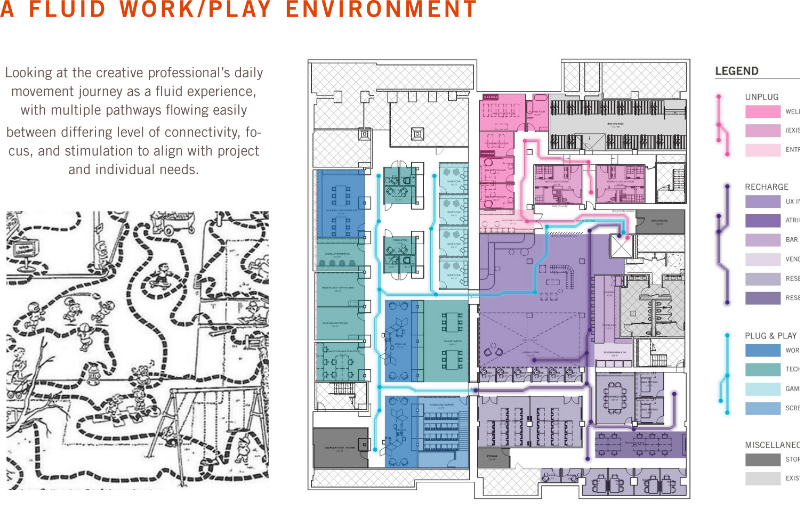
The journey begins with Unplug, a zone modeled after a hotel lobby and spa. More than just a threshold, it’s a transition into a calm mindset, welcoming users with biophilic design and warm materials. Infrared and sensory therapy rooms, meditation alcoves, and yoga spaces encourage mindfulness, while spa-like locker rooms and even cold plunge pools offer physical reset. It’s an environment designed to help employees slow down and feel cared for, establishing wellness as the foundation of creativity.
Zone 2: Community as Catalyst
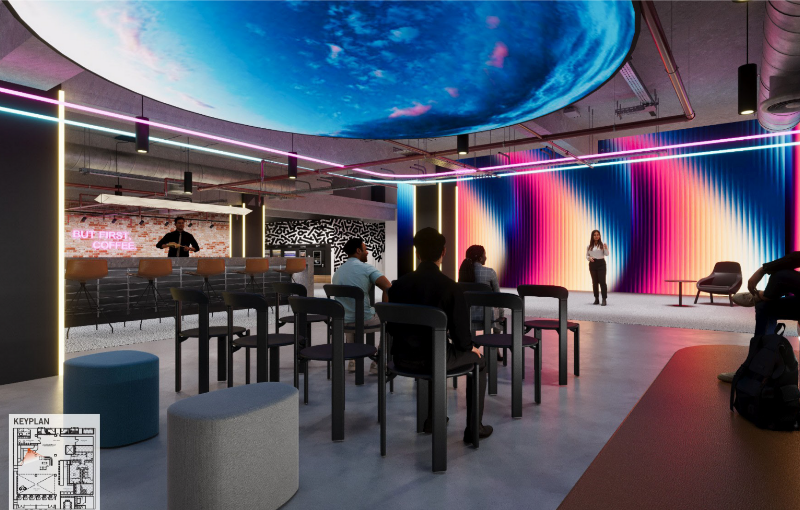
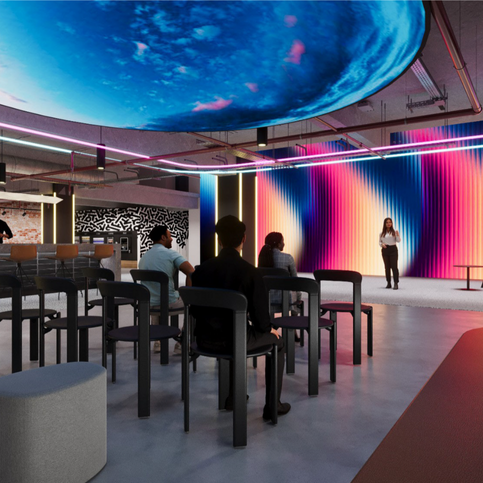
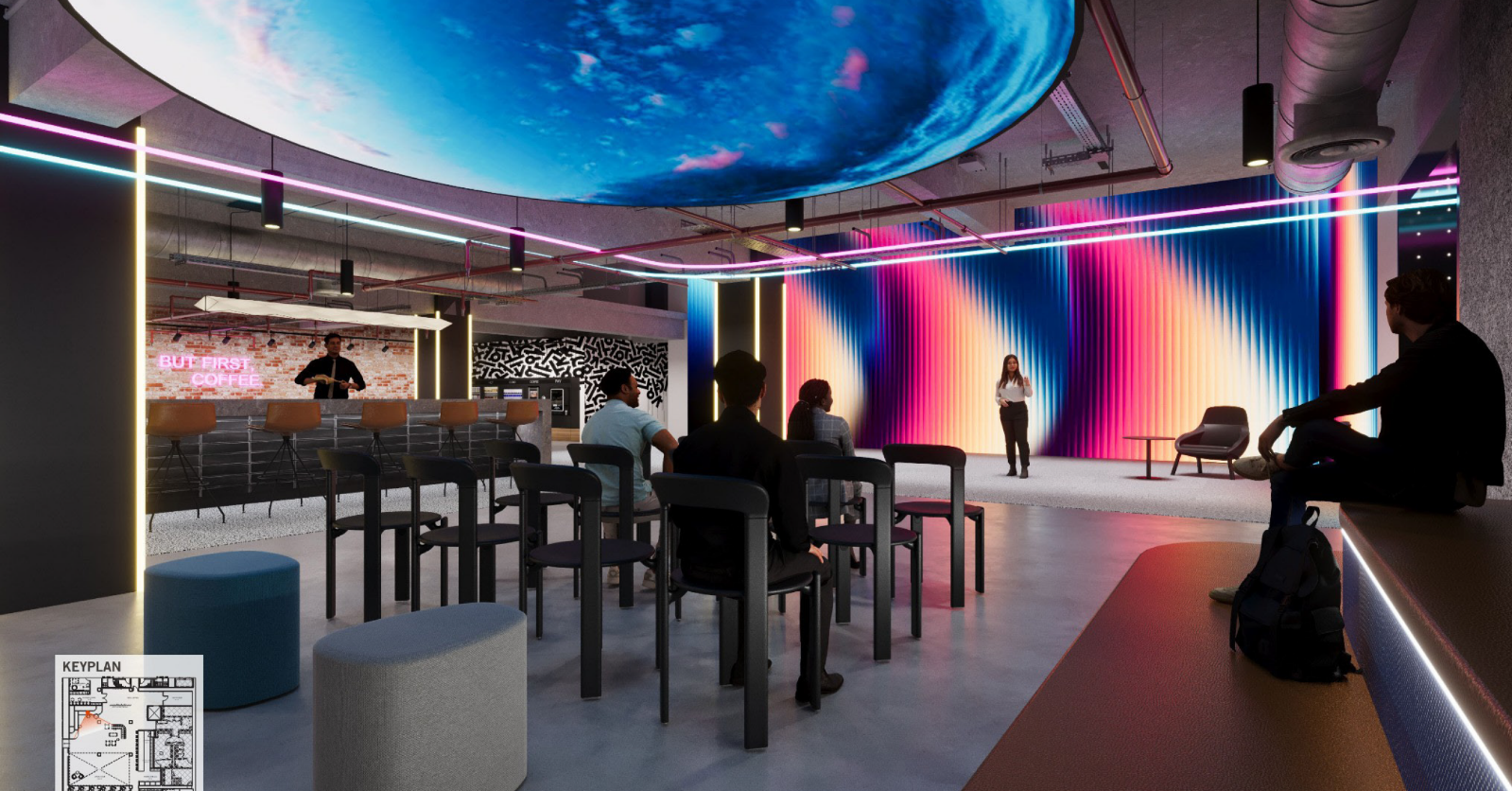
At the heart of the space is Recharge, pulling the best hospitality elements from spaces such as ballrooms and bars. Here, a flexible innovation lounge invites brainstorming and workshops, while a stage supports presentations and knowledge-sharing. A social bar and curated healthy vending concept blend hospitality and tech culture, providing an elevated model for workplace cafés with atmosphere blending with convenience. Scaled-down micro meeting pods allow moments of focus without breaking the flow. The design balances spontaneity and structure, creating a setting where community and collaboration can thrive.
Zone 3: Plug into Creation
Tying it all together is Plug & Play, offering spaces for production, experimentation, and rest. Part guest room, part lab, it houses enclosed and open work studios, tech-forward prototyping spaces, and immersive AV and VR/AR environments. Game rooms and a screening lounge round out the experience, acknowledging that inspiration often emerges in moments of play. Here, insight seamlessly transforms into output, supporting both individual and team-driven breakthroughs.
Daily Fluidity, Individual Journeys
What makes this project distinct is not its list of features but its underlying philosophy. By drawing on hospitality’s ability to craft narrative, sequence, and emotional resonance, the design transforms workplace amenities into a fluid, non-linear journey. Employees move organically between zones of calm, connection, and creation, aligning their environment with personal rhythms and project demands.
Rather than being tethered to a single static workstation, employees move fluidly through a series of zones designed to support the natural rhythm of their day. Each area is intentionally crafted to align with varying task types and focus levels encouraging movement from open, collaborative hubs to quieter, heads-down settings, and onward to restorative spaces that allow for pause and decompression.
The physical design of the office is conceived as a continuous, interconnected journey rather than a collection of isolated rooms. Transitions between zones are deliberately choreographed: changes in lighting, material texture, ceiling height, and acoustic quality subtly cue shifts in energy and purpose. Circulation paths act as connective tissue—broad enough to invite spontaneous interaction yet defined enough to preserve the integrity of each distinct work mode.
Employees might begin their morning in a bright, social project area for team alignment, move to a semi-enclosed nook for concentrated development, and end their day in a calming retreat space to reflect or reset. The flow between these zones is intuitive, promoting natural shifts in pace and mindset.
Throughout, consistent design elements such as shared materials, color accents, and wayfinding cues, anchor the experience and maintain a sense of cohesion. The result is a workspace ecosystem that supports dynamic patterns of work, enhances well-being, and fosters both individual focus and collective creativity.
This design approach challenges assumptions about the modern office. Rather than separating work from socializing, or treating amenities as add-ons, it creates an ecosystem where every moment – arrival, gathering, retreat – contributes to wellbeing, culture, and innovation. By integrating wellness, innovation, and flexibility, this project proposal focused on redefining how space can catalyze progress. These environments don’t just support the tech workforce – they shape its future by sparking connections, fostering experimentation, and fueling the momentum to turn vision into action.
Ware Malcomb brings extensive hospitality expertise across multifamily, mixed-use, hotel, restaurant, and food and beverage environments, delivering high-quality design solutions that blend innovation, efficiency, and market insight. With services spanning architecture, interior design, civil engineering, branding, and master planning, the firm creates vibrant, experience-driven destinations that maximize long-term real estate value. From boutique hotels and premium branded properties to quick-service restaurants and large-scale mixed-use campuses, Ware Malcomb’s multidisciplinary approach, efficient project delivery, and integrated branding strategies ensure memorable, market-responsive spaces that connect people, place, and culture.
Through this multi-disciplinary team’s application of a hospitality lens to tenant improvement design, Ware Malcomb was able to create a vision of the office not as a static workplace, but as a dynamic destination.