

Because cortisol responds as much to environmental conditions as it does to physiology, laboratories studying cortisol are uniquely vulnerable to a simple truth: design decisions can influence science.
Cortisol modulation refers to the regulation and measurement of cortisol levels to understand physiological responses to stress, circadian rhythms, immune function, and disease risk. Often called the “stress hormone”, cortisol is typically analyzed using one or more biological sample types, each with distinct spatial and environmental implications:
- Saliva – Used to assess acute stress markers and diurnal variation. Salivary cortisol collection is highly sensitive to external stimuli, requiring calm, controlled environments during collection and handling.
- Hair – Provides a record of long-term cortisol exposure over weeks or months. Hair analysis requires contamination-resistant processing zones and precise sample tracking.
- Blood – Used to assess systemic hormonal levels and immune response. Blood-based cortisol studies demand higher biosafety standards, strict temperature control, and enhanced staff protections.
Cortisol modulation research sits at a unique intersection of biology and the environment. Cortisol is profoundly sensitive to external conditions, fluctuating in response to light, temperature, noise, and perceived stress. For labs studying cortisol, facility design is not neutral. It directly impacts data integrity.
In cortisol-focused facilities, pre‑analytical conditions such as sample collection, handling, storage, and even staff experience must be tightly controlled to avoid introducing confounding variables and ultimately, influencing research outcomes.
Sanitation & Environmental Control
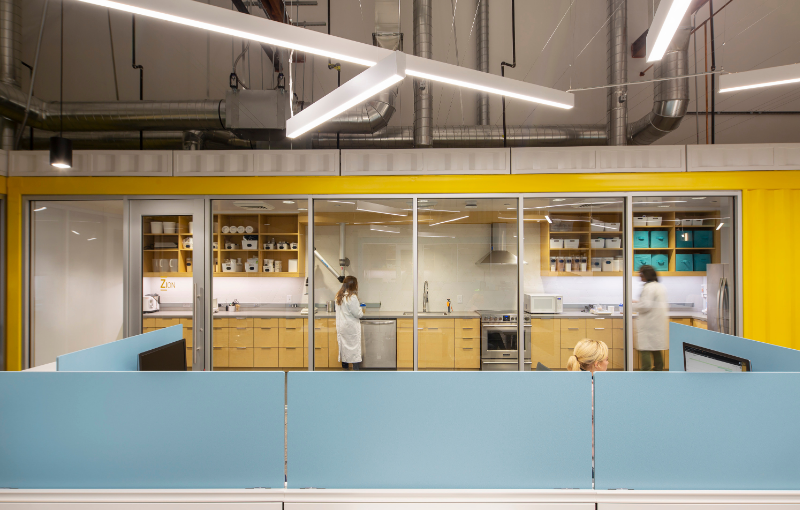
Protecting sample validity begins with uncompromising environmental control. Effective lab design must balance rigorous sanitation, precise environmental regulation, and biosafety requirements in ways that protect both specimens and staff, using layouts and systems that reinforce compliance rather than complicate it. Some targeted strategies that support this approach include:
- Highly sanitary spaces – Seamless materials, flush-mounted casework, and minimized dust traps reduce contamination risks, especially for saliva and hair samples.
- Advanced HVAC systems – Effective cortisol modulation labs require:
- Tight temperature and humidity stability
- Robust air filtration to reduce particulates and biological contaminants
- Pressure relationships and zoning by sample type, preventing cross-contamination
- Safety considerations – Blood and other sensitive biological samples require biosafety-level-appropriate layouts that support staff safety without over-complicating workflows.
Beyond equipment and protocols, the building itself must reinforce operational discipline. Clear labeling workflows and intuitive adjacencies reduce handling errors, while secure, well-defined chain‑of‑custody paths protect sample integrity as specimens move through the lab. Built‑in redundancy, including backup power, alarmed monitoring, and resilient infrastructure, safeguards against inevitable equipment or system failures. Effective lab design assumes disruptions will occur and ensures they never compromise data, samples, or research outcomes.
Sample Storage & Preservation
Once cortisol-related samples are collected, preserving their integrity becomes an exercise in precision and foresight. Storage environments must maintain absolute thermal and procedural consistency across days, months, or even years of study, leaving little margin for failure. In this context, architectural and interior design decisions directly determine operational resilience, shaping how effectively laboratories protect irreplaceable samples, maintain chain of custody and ensure data reliability over time.
Cold Storage
Cold storage is essential to cortisol modulation laboratories, requiring thermal strategies that are both precise and resilient. Short‑term storage for saliva and processed blood samples relies on low‑temperature refrigeration located close to analysis zones, enabling quick access while minimizing handling and temperature drift. Long‑term studies depend on ultra‑low temperature (–80 °C) freezer environments, often organized into high‑density freezer farms designed for scalability and continuous operation. Built‑in redundancy—such as N+1 freezer capacity, emergency power, alarmed monitoring, and planned sample migration protocols—is critical to protecting specimens and maintaining data integrity over the life of a study.
Liquid Nitrogen
For highly sensitive blood and biological specimens, liquid nitrogen storage adds a distinct layer of architectural and engineering complexity. Facilities must incorporate robust ventilation systems with oxygen displacement monitoring to mitigate asphyxiation risk, along with clearly separated fill and storage zones to support safe operations and maintenance. Structural capacity must also be carefully evaluated to accommodate the significant weight of liquid nitrogen dewars, ensuring long-term safety, compliance, and uninterrupted specimen preservation.
Neurodiversity, Stress, and the Future of Lab Design
While bench‑level controls are essential, cortisol modulation research benefits from environments that actively reduce stress for the people inside them. Extensive evidence shows that access to nature and daylight lowers baseline cortisol, making biophilic design an alignment with science rather than just a luxurious design feature.

Views to the outside from staff work areas and break spaces support visual recovery during cognitively demanding work, while carefully controlled daylight helps maintain circadian alignment critical to hormonal research. Integrated greenspaces, including interior plantings in non‑sterile zones and courtyards or gardens adjacent to labs and offices, offer opportunities for decompression without disrupting workflows or safety protocols. Together, these strategies help stabilize physiological stress responses, reduce unintended variability and reinforce research integrity.
Cortisol‑sensitive facilities also benefit from recognizing the diverse sensory needs of lab staff. Neurodiversity‑informed design directly supports performance, focus, retention, and safety and can be implemented without changes to PPE or sterility standards. Dedicated spaces for focused work support data analysis and documentation, while separate zones for informal collaboration allow communication without disturbing controlled lab environments. Clear visual cues that distinguish quiet areas from more active ones help reduce cognitive load and allow staff to regulate sensory input throughout the day. The result is a flexible, inclusive workplace that minimizes stress‑related errors without compromising safety or compliance.
Human‑Centered Design Strategies for the Lab Workplace
- Integration of greenspaces
- Interior plantings
- Courtyards or healing gardens
- Adjustable lighting schemes – Circadian-friendly, glare-free lighting supports focus and reduces fatigue—especially important for early morning or late-day cortisol studies.
- Acoustic controls
- Pink noise systems to support concentration
- Reduced mechanical noise through vibration isolation and thoughtful equipment placement
- Quiet zones and decompression spaces – Short breaks in low-stimulation environments can measurably reduce stress and improve accuracy upon return to work.

Cortisol modulation research makes one thing clear: when the hormone under study is shaped by its environment, laboratory design becomes inseparable from scientific validity. From environmental control and resilient storage to biophilic and neurodiversity‑informed workplaces, every design decision either reduces or introduces risk. The most successful cortisol-focused laboratories are those that recognize design not as a backdrop to research, but as a critical tool for protecting data integrity, supporting human performance, and enabling better science.